
Compare Osborne County Property Values
An Osborne County property value may mean an appraised amount, an assessed amount, or a recorded sale price. Each figure comes from a different record. Merging them invites errors. Kansas applies classification rates to appraised value to reach assessed value: residential property uses 11.5 percent, commercial and industrial real property uses 25 percent, and agricultural land is valued by use. Treat the three amounts as separate answers to separate questions.
| Value | What It Is | Where |
|---|---|---|
| Assessed value | Tax base after classification | Appraiser record |
| Appraised value | County mass-appraisal estimate | Appraiser record |
| Last sale price | Consideration from a transfer, if recorded | Deed or verified parcel card |
| Land and improvements | Separate components, if shown | Live parcel card |
Assessed value does not predict a sale. A buyer and seller agree on a transaction price at one moment, while the county values thousands of parcels for taxation under uniform state rules.
Estimate an Osborne County Property Value
Start at the CIC appraiser entry. Confirm the tax year, value labels, property class, and update date on the live parcel card. If it will not load, call the Appraiser.
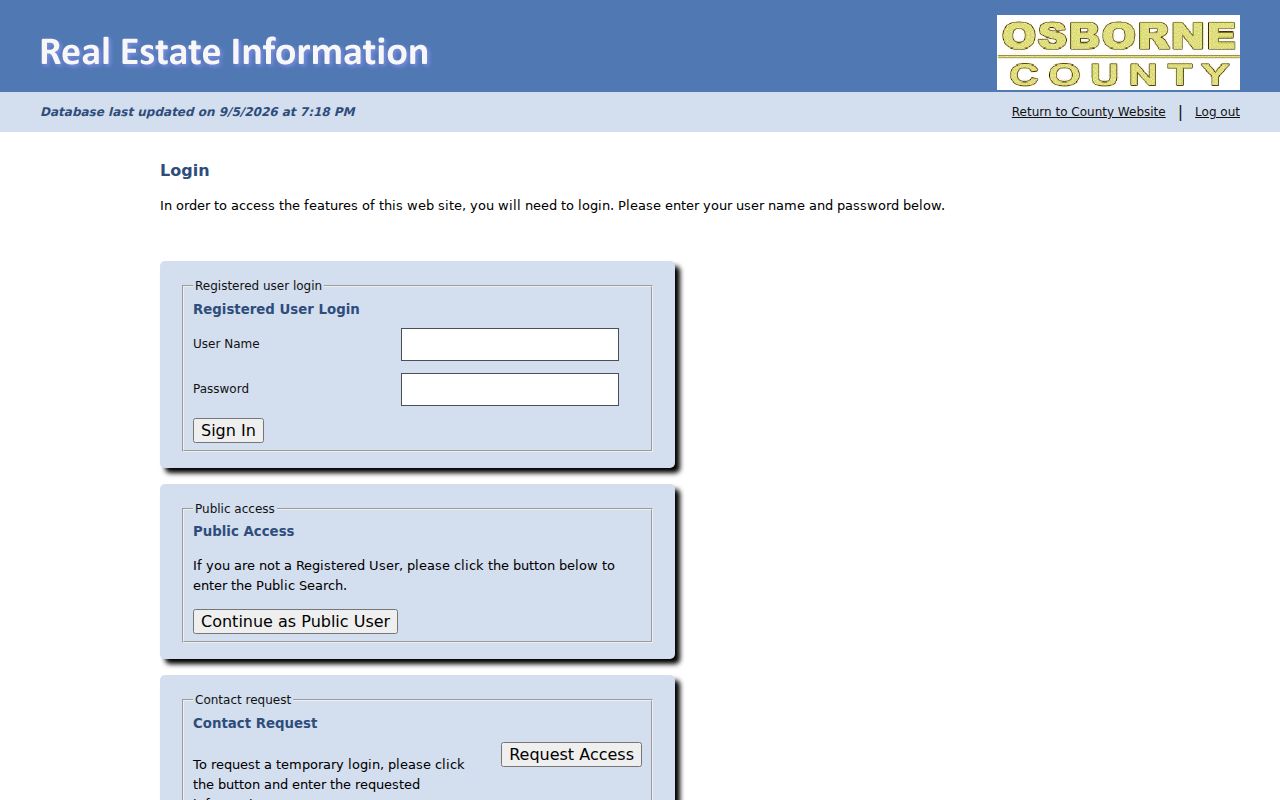
The public-access entry leads into the appraiser data. Value labels still need confirmation on a live parcel card or through the Appraiser's office.
- Match the address to the parcel ID and legal description.
- Record appraised and assessed values with their tax year.
- Apply the stated class rate only when checking the published formula.
- Read a recorded sale separately and note its date and deed.
- Assessed value
- The tax base after the class rate.
- Appraised value
- The county's mass-appraisal amount.
- Assessment ratio
- The class percentage applied under Kansas rules.
Understand Osborne County's Value Formula
The Kansas Department of Revenue formula links appraised value, assessment rate, assessed value, and mill levy. Classification explains why two property types with the same appraised figure can carry different assessed amounts. Agricultural land is valued by use, not by market. Do not compare it to a residential parcel.
Read Osborne County Market Studies
The county's 2026 market study describes residential, commercial, and vacant-lot markets as generally upward, while warning that parcel-specific traits and corrections can move individual values. The trend is countywide. It is not an appraisal of one home. The Appraiser inspects real property on a six-year cycle. Updated characteristics feed mass appraisal, which explains a value change without implying a new sale.
Place Osborne County Values in Context
The 2024 state summary reports $66,910,443 in Osborne County taxable value. Agricultural land made up 39.87 percent and residential property 23.37 percent, with utilities, commercial property, farm improvements, and oil and gas in separate classes. Those shares describe the county tax base. They do not set any parcel's value.
Separate Osborne County Sale Price
A deed may carry consideration. A parcel card may show a last-sale field when the live record exposes it. The recorder publishes no public remote index. Request the latest deed using the parcel's legal description instead. A family deed, estate conveyance, quitclaim, or other non-market transfer can make consideration a poor comparison. So the date and deed type matter.
Verify Osborne County Value Fields
The CIC entry mixes public access with registered-login controls. If the public view will not load, call the County Appraiser at 785-346-2310 and ask for an existing property card tied to the precise address, parcel ID, or legal description.
Ask staff to name the tax year, appraised value, assessed value, property class, land and improvement components if maintained, and update date. Copy the labels exactly. A field named market, appraised, or taxable carries a specific meaning, so substituting a casual synonym can spoil a comparison.
Confirm the situs, owner label, and legal description all identify the intended tract. Comparing figures from different years without labels is a quick way to invent a false increase or decrease.
Class Shapes Osborne County Assessment
Kansas class rates explain why appraised and assessed value differ. Residential real property is assessed at 11.5 percent. Commercial and industrial real property uses 25 percent. Agricultural land is valued by use rather than by the residential approach. Utilities, oil and gas, and agricultural improvements remain distinct classes in the county tax base.
First confirm the class shown for the parcel. Then use the state formula as a check, not a substitute for the official record. A mixed-use tract or corrected class may need staff explanation. The mill levy enters the tax calculation later. Keep it out of the assessed-value meaning.
The county composition figures give broad context only. They do not predict which class applies to one address. They do not say what that parcel could sell for.
Explain Osborne County Value Changes
Why did a Osborne County parcel value change? The answer usually lies in one of a few places. A new valuation year can move the number. Corrected parcel facts, a physical change, or a reclassification can too. Market-study inputs matter, and so does the inspection cycle. The Appraiser inspects real property on a six-year cycle. Still, no rule says every parcel shifts by the same amount. Nor must a change wait for its inspection year.
Pull two official property records cards and compare them field by field. Look at the year, land class, building traits, improvement status, exemptions, and any correction date. City permit or code files may explain construction, demolition, or occupancy. An unsafe-building action can show up there as well. Osborne, Downs, and Natoma all keep such files. Those files add context but never set the county value.
When the real question is a challenge to the assessment, shift to the property-tax process. The same goes for the size of the bill. Keep the comparison anchored to the valuation numbers. Watch what each one means and where it came from.
Compare Osborne County Value Years
A clean trend starts with the right raw material. Use the same parcel, the same value label, and clearly named years. Save each card or office response with its retrieval date. Compare appraised value to appraised value, and assessed value to assessed value. Never drop a deed consideration amount into the same series. Label it as a sale record instead.
Check the legal description, acreage, class, and improvements between the years you are comparing. Something may have changed. A split parcel can make an ordinary shift look like pure appreciation. A combined tract can do the same. A correction can also rewrite a prior fact with no market event behind it. Rather than guessing, ask the Appraiser to explain the maintained record.
Countywide statements deserve their own note. Broad class trends across Osborne County cannot substitute for a single property's history. They also cannot stand in for a city rate. Keep the parcel-level property records comparison separate from the big picture.
Keep Osborne County Values Separate
Build a comparison table or a notes page. Give it four labels: amount, value type, effective or sale date, and source. The appraiser record supplies appraised and assessed amounts. The deed is the source for recorded consideration when it exists. A private appraisal belongs outside the county-record column. So does an asking price or a later sale estimate.
Exemptions and the tax bill shape what a taxpayer owes. They do not redefine the base concepts. A mill levy likewise converts assessed value into part of the tax calculation. It is not another property value. Keeping these pieces apart stops a tax total from being described as land worth.
For bills, exemptions, or appeal steps, use the county tax-record process. For recorded consideration, request the transfer instrument. Each office answers only for the field it maintains. Osborne County property records stay clearest when the sources stay labeled.
Limit an Osborne County Value Estimate
An assessor value exists to serve the tax system. It is not a boundary finding or a title opinion. It is also not a promised sale price or a deal-ready appraisal. Check the legal description and the year before comparing any property records.
Follow the Osborne County tax record process for bills or appeals. Attach the source label, effective year, parcel class, and retrieval date to every figure you keep. When two official records conflict, ask the office that maintains each field to explain or correct its own entry. Do that before you draw a conclusion.
Value is not price. An Osborne County assessed value supports taxation and does not state what the property would sell for.