
Identify an Osborne County Owner
The quickest path begins at the Osborne County CIC public-access entry. Its opening screen loads for anyone, while the live parcel fields sit behind registered-user controls. If the public doorway will not open, call the Appraiser or ask for an existing parcel card directly. The CIC access screen shown below marks the line between public entry and registered access.
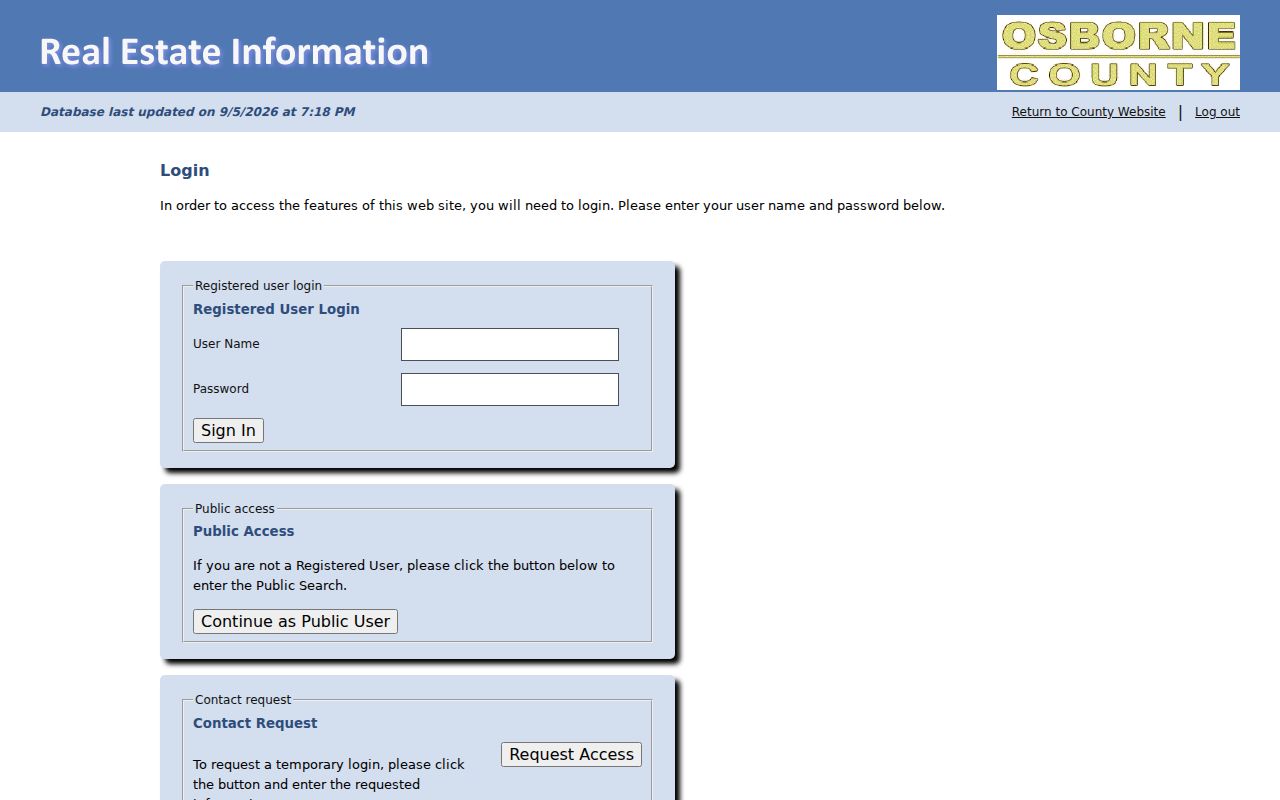
That screen tells you where the owner search starts. It does not replace the deed comparison. Always check the deed before relying on the name that appears.
- Match the street address or legal description to the correct Osborne County parcel.
- Read the appraiser's owner-of-record label and preserve its update date.
- Ask the Register of Deeds for the latest deed tied to the same legal description.
- When an entity owns the land, check its exact name in the Kansas business search.
Following this flow shows who owns the indexed interest far better than a name alone. It also exposes the gap after a sale, when the deed is newer than the appraisal roll.
Trace Osborne County Ownership Sources
Each official source covers one piece of the answer. The appraisal roll serves as the practical current index. The deed is the recorded conveyance itself. ORKA locates a tract, and the Secretary of State can identify a Kansas entity behind the parcel.
| Source | Owner Info It Gives | Access |
|---|---|---|
| Appraiser roll | Owner label and parcel identity, if shown live | CIC entry or office request |
| Register of Deeds | Latest grantee and recorded legal description | Office, mail, or KORA request |
| Secretary of State | Entity status, agent, formation, and filings | Free state search |
| ORKA map | Spatial context and map layers | Public map or REST service |
An owner of record is not always the person living there. The tax-mailing line may lead to a post office box, an estate, a care-of address, a lender, an out-of-county address, or a protected substitute address. Use that address only for lawful property contact. Never treat it as proof that someone occupies the site.
Confirm the Osborne County Grantee
The Osborne County Register of Deeds records deeds, mortgages, releases, liens, surveys, plats, and related instruments. The office uses computer indexing, scanning, and microfilming. But it publishes no remote grantor-grantee portal and no online cutoff year. Bring the appraisal owner name, the parcel ID, and the full legal description. Ask for the latest deed entry with its date, grantor, grantee, book and page or instrument reference. Also request any connected releases. Matching the legal description matters more than matching a surname.
Identify an Osborne County Entity
A parcel may be vested in an LLC, a corporation, a trust, or an estate. Run the exact entity name through the Kansas Business Entity Search. It accepts a name, a business ID, or a current resident-agent name. Broad matches return only the first 200 results, so narrow common names. A result can show the legal name, status, formation date, resident agent, registered office, and filing links. It does not prove the agent owns the parcel. Trusts and estates may still require a deed, a probate file, or a recorded affidavit.
- Owner of record
- The party named on the current public roll.
- Grantee
- The party receiving an interest in a deed.
- Situs
- The physical parcel address.
- Mailing address
- The notice destination, which may be elsewhere.
Request Osborne County Owner Records
When online access fails, call the Appraiser at 785-346-2310 for an existing parcel card, and the Register of Deeds at 785-346-2452 for the indexed deed. A written request can go through the county's public-record request form. Name the record, parcel, legal description, date range, and format. KORA generally requires a response, production, or a delay explanation by the end of the third business day. It does not require the county to create a new ownership report. Search and copy charges may apply.
Separate Osborne County City Files
City zoning and permit files describe use, approvals, and code history. They do not transfer title. Osborne planning records, Downs forms, and Natoma permit files can add context once the parcel is identified. But the owner answer still comes from county appraisal and deed records. The split matters most near a city edge. ZIP geography, incorporated limits, and planning jurisdiction can diverge there. Use the legal description and county parcel first. Then ask the correct city for its file.
Match Osborne County Owner Descriptions
A legal description is the best bridge in several situations. Use it when a street address is missing, old, or shared by more than one improvement. City parcels typically use lot, block, addition, and city. Rural parcels rely on section, township, range, acreage, and sometimes metes-and-bounds calls. Copy all fraction and “part of” language. A split tract can otherwise point to the wrong owner.
The county foreclosure list shows why exact text matters. Its public entries combine a person or entity name and a hyphenated tax identifier. They also include legal descriptions involving places such as Fifield's 2nd, Union Tracts, Austin, Madden, and Ray. An entry only signals foreclosure eligibility. It does not confirm a completed sale or a new owner. Use its clues to locate the parcel. Then return to the appraiser and the deed records.
Respect Osborne County Owner Privacy
Kansas public-record law starts from access. Specific records and data can still be restricted. The Safe at Home program gives eligible participants a substitute address and mail forwarding. That substitute mailing line is an intentional safety measure. It is never an error to work around.
The county also has no duty to build a new owner profile from several databases. Ask for an existing parcel card, index entry, deed, or map instead. That narrower approach protects accuracy. It also keeps the search tied to public records the custodian actually holds.
Check Osborne County Foreclosure Status
Osborne County's treasurer keeps a tax-foreclosure eligibility list. It names each owner or entity, the tax identifier, and the legal description. Inclusion does not settle anything by itself. It signals eligibility, not a completed sale. Before drawing any conclusion about ownership, check the current appraisal roll and the most recent deed on the parcel. The treasurer can also explain what a listing means for a specific property. Keep in mind that a foreclosure deed, a court judgment, or a later conveyance can transfer ownership. An eligibility notice alone never does.
Test an Osborne County Owner Match
A single matching name proves little in Osborne County. Initials repeat. Family names repeat. Entity abbreviations repeat too. So test any owner-of-record result against several independent fields before trusting it. Start with the situs. It should describe the place you actually mean. The parcel or tax ID should match across the appraiser, the treasurer, and the GIS map. Then compare the legal description on the latest deed. It should cover the same lot or rural tract. The deed date should also make sense next to the appraisal database update date. Disagreements deserve a direct question. If a recent deed and the current tax roll conflict, ask the recorder whether the instrument is indexed. Then ask the appraiser whether an ownership update is pending. Differing legal descriptions are a louder warning: stop, find the right parcel number, then continue. A mailing-address mismatch alone is weaker than it looks. Notices often go to a post office box, a fiduciary, an office, or an owner living elsewhere. The same discipline carries over to mineral, easement, and mortgage records. Those documents can name interested parties. None of them becomes the fee owner of the surface parcel by that fact alone. Read the instrument type and the interest conveyed, not just the names in the deed index.
Prepare an Osborne County Owner Request
A good office request starts with the strongest identifiers. Include the street address, the tax ID, the complete legal description, the likely owner spelling, and a useful date range. Ask the appraiser for the existing property card and its update date. Ask the recorder for the newest deed index entry and its image. Name the fields you need rather than asking staff to decide who owns the property. That division of labor matters in Osborne County. The appraiser maintains the assessment record. The Register of Deeds preserves recorded instruments. The treasurer handles the tax account and any foreclosure status. A city use question may remain after the county parcel is fixed. The municipal office can supply zoning or permit records in that case. Visiting in person works best with cross-reference keys in hand. Ask which index or record series is current. Before ordering copies, identify the exact pages or instruments. This approach cuts cost. It avoids pulling unrelated names. It also leaves a clear trail showing why the final owner-of-record match was chosen.
Limit an Osborne County Owner Lookup
Every lookup has limits. An owner search cannot prove occupancy, clear title, an exact boundary, or the absence of an unrecorded interest. Kansas Safe at Home participants may use a substitute address, and other restricted or redacted data can keep private details out of the public file.
Lawful use. Osborne County owner records support due diligence and research. Never use owner data to stalk, harass, target, or harm anyone.